






Impact Dynamics Research Facility
From NasaCRgis
| Facility 1297 | |
|---|---|
| | |
| Center: | Langley Research Center |
| Location: | Hampton, Virginia |
| Year Built: | 1965 |
| Historic Eligibility: | National Historic Landmark |
| Important Tests: | Lunar Excursion Module (LEM), Jet Shoes |
| Back To Multimedia |
Contents |
[top] Tours
Watch the Construction of the LandIR Hydro Impact Basin
[top] History
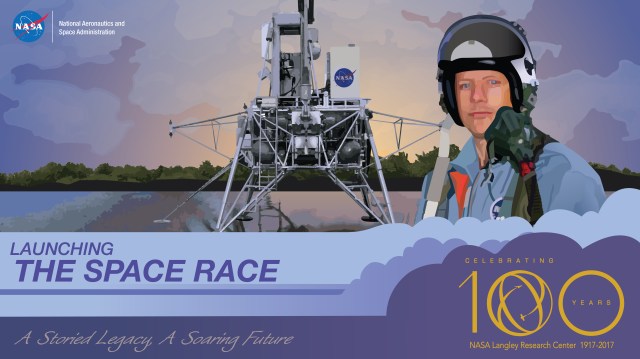
When President John F. Kennedy confidently predicted in 1961 that the United States would land a man on the Moon by the end of the decade, the task of implementing what seemed to be a wildly ambitious goal fell to the engineers of the National Aeronautics and Space Administration (NASA). The success of the chosen lunar-orbit rendezvous (LOR) strategy ultimately depended on whether the astronauts could learn to safely land the Lunar Excursion Module (LEM) on the Moon’s surface and return into orbit to dock with the mother ship. A major obstacle in designing a training procedure, however, was that the LEM would handle far differently in the Moon’s atmosphere, with 1/6th the gravitational pull of Earth’s. The problem thus became how to reproduce the operation of the LEM in a low gravitational environment. The solution was conceived as an erector set model in the home workshop of W. Hewitt Phillips (see autobiography of W. Hewitt Phillips). The solution came in the form of the Lunar Lander Research Facility (LLRF), a training simulator that allowed NASA engineers to study the complex lunar landing process and give the Apollo astronauts critical hands-on pilot training in the LEM. Completed in 1965 at a cost of $3.5 million, the most obvious feature of the LLRF was its enormous gantry, an A-frame steel structure measuring 400 feet long by 240 feet high. The LLRF simulated lunar gravity on the LEM through an overhead partial-suspension system that counteracted all but 1/6th of the Earth’s gravitational force, and allowed the vehicle to fly unobstructed within a relatively large area. The LLRF also was used as a lunar-walking simulator, with subjects walking on inclined planes while suspended by a system of slings and cables.
Until the end of the Apollo program in 1972, the LLRF was used to train 24 astronauts for lunar missions, including Neil Armstrong and Edwin E. “Buzz” Aldrin, Jr., of Apollo 11, the first men to walk on the Moon. Armstrong offered what was perhaps the greatest tribute to the importance of the LLRF in the success of the Apollo program. When asked what it was like to land on the Moon, he replied: “Like Langley.” (See US Postal Service stamps issued in September 1969 depicting the "First Man on the Moon.")
Although the end of manned lunar missions made the LLRF redundant by the early 1970s, NASA quickly found a new use for this Langley landmark, converting it into a full-scale aircraft crash test facility. Redesignated the Impact Dynamics Research Facility (IDRF), it was used to conduct important research on aircraft and other vehicles between 1974 and 2003. With no foreseen future mission need for the IDRF and with limited funding for maintenance and upkeep of such a large structure, NASA closed the facility in 2003 and it was placed on the list of buildings and structures planned for demolition at LaRC. As luck would have it, with President Bush’s announcement in 2004 of the Vision for Space Exploration, NASA determined that the IDRF could be adaptively re-used to support the Agency’s new Constellation Program.
The facility was re-opened in 2005 to conduct landing tests associated with the development of the Crew Exploration Vehicle (CEV) named ORION. Ironically, the testing would be remarkably similar to the original purpose of the LLRF – testing of the LEM. The facility was re-named the Landing Impact Research Facility (LandIR) and minor modifications were made to include installation of a new parallel winch system to support full-scale ORION testing, and replacement of an elevator. Since NASA needed the capability to determine if the ORION landing would be via land or water, a more significant modification involved installation of a new hydro-impact basin (splashdown pool) underneath the Gantry. Construction of the hydro-impact basin, which is 115 feet long, 90 feet wide and 20 feet deep, was completed in January 2011. Although the Constellation Program has since been cancelled by President Obama, the LandIR plans to continue performing impact testing since the ORION capsule will still be used to service the International Space Station.
The historical significance of the LLRF and its many contributions to the U.S. space program were formally recognized when the facility was designated a National Historic Landmark in 1985. The LEM, designated a national historic landmark in 1986, is on display in the Virginia Air and Space Center/Hampton Roads History Center.
[top] Photos
[top] Gantry
[top] Support Buildings
[top] Additional Photos
[top] Films
1964: Exploratory Study of Man's Self-Locomotion Capabilities with a Space Suit in Lunar Gravity
1966 Self Locomotion in Earth and Lunar Gravity
1966: Comparative Measurement of Man Walking and Running in Earth and Simulated Lunar Gravity
1968: Study of Man's Capability for Self-Locomotion on the Moon
1976 Full Scale Crash Test of a CH-47C helicopter
1989 Apollo Program Panel Discussion
Crash Tests of Four Identical High-Wing Single-Engine Airplanes
Apollo 40th Anniversary Presentation
Aircraft Crash Tests Composite Data Film
[top] Interviews
The Evolution of the Lunar Landing Research Facility (Stewart)
Technological Innovations in the Design of the Lunar landing Research Facility (Stewart)
Lee Person on His Career: July 21, 2010
[top] Documents
1963 Original Construction Plan of Complex
1966 Quick Facts on Lunar Landing Research Facility
1966 Technical Facilities Resume
2007 NASA's Gantry: Past, Present and Future Asset to Exploration
1967 One-Man POGO Flying Device Studied at LLRF
1969 Moon Landing Stamps. The Times-Herald. Newport News, VA. 10 September 1969
1969 Times Herald Article: Moon Landing Practice Bears Fruit
1979 A Unique Facility for VSTOL Aircraft Hover Testing
2003 Designing the Lunar Landing Research Facility, Hewitt Phillips
2006 Historic American Engineering Record: Gantry
2007 NASA's Gantry: Past, Present and Future Asset to Exploration
2007 Gantry Reconstruction: Out with the Old and in with the New
2008 NASA's Airbag Drop Tests in Full Swing
2010 Chopper Crash Test a Smash Hit
[top] Apollo and Mercury
1959 Project Mercury Special Excerpt
1962 Photo of Apollo Lunar Model
1963 Apollo Team to be Chosen by mid-'62
1964 Short Description of Lunar Gravity Simulation
1967 Manned Space Flight: Projects Mercury and Gemini
1968 Apollo 8: Man Around the Man
1968 Medical Benefits from Space Research
1969 Astronauts Will Be Quarantined
1969 Mission Report of Apollo 10
1969 Two Revolutions Added to Apollo 11
1969 Apollo 11 Television Schedule
1969 Historical Moon Mission Set for Launch Wednesday
1969 Cubs and Phillies Honor Apollo 11
1969 Armstrong, Aldrin Step Onto Surface (Daily Press)
Daily Press Headline: "We Walk On Moon"
1969 Daily Press Nixon on Lunar Landing
1969 Daily Press: "Tranquility Base Here; The Eagle Has Landed"
Daily Press World Cheers Landing
1969 Times-Herald Apollo Craft Procedures
1969-07-21 Times Herald Astronauts Discard Expensive Junk Pile
1969 Times-Herald Crew Ends Moon Visit
1969 Times-Herald Laser Beams Return from Moon Reflector
1969 Times-Herald Man Gains Toehold in Heavens
1969 Times-Herald Parents Proud of Son
1969 Times-Herald Two Men Go Walking On Moon
1969 Times-Herald Wives Couldn't Believe It Either
1969 Times-Herald Moon Bugmobile To Keep Astronauts In Isolation
1969 Times-Herald Officials Emphasize Apollo 11
1969 Times-Herald Woman Calls Apollo Hoax
1969 Apollo 11 Successful, Man Walks On Moon
1969 In This Decade: Mission To The Moon
1969 Manned Space Flight Apollo
1970 First Anniversary of Apollo 11 Moon Landing
1972 Tenth Anniversary of John Glenn's Space Flight Observed
1979 Apollo 11 Commemorative Certificate
1994 Langley's Behind-the-Scenes Work Helped Launch Apollo 11
1994 Open House Offers a Glimpse of the Past and a View into the Future
25th Anniversary Apollo 11 Stamps To Be Issued
Best Regards from John Glenn (Astronaut)
NASA Facts: Mariner Spacecraft
NASA Facts: Space Launch Vehicles
1966 Surveyor I: A Preliminary Report
2012 Hydro Impact Basin and Orion Crew Exploration Vehicle
[top] Awards
[top] For Students and Teachers
The Lunar Landing Research Facility allowed astronauts to practice landing a lunar module on the moon and how to walk in a 1/6th gravity environment. The facility was designed by Langley Research Center engineer Hewitt Phillips.
The lunar module used hydrogen peroxide as its fuel source and it was suspended from a 73 meter high gantry. The gantry was 122 meters long, and the combination of this height and length let the module move in all directions. The module could even roll when suspended from the gantry! The astronauts liked this simulator because if the module started pitching and rolling uncontrollably testing would stop and the astronauts would be hanging safely from the gantry. This was a much better alternative to an out of control module crashing to the ground.
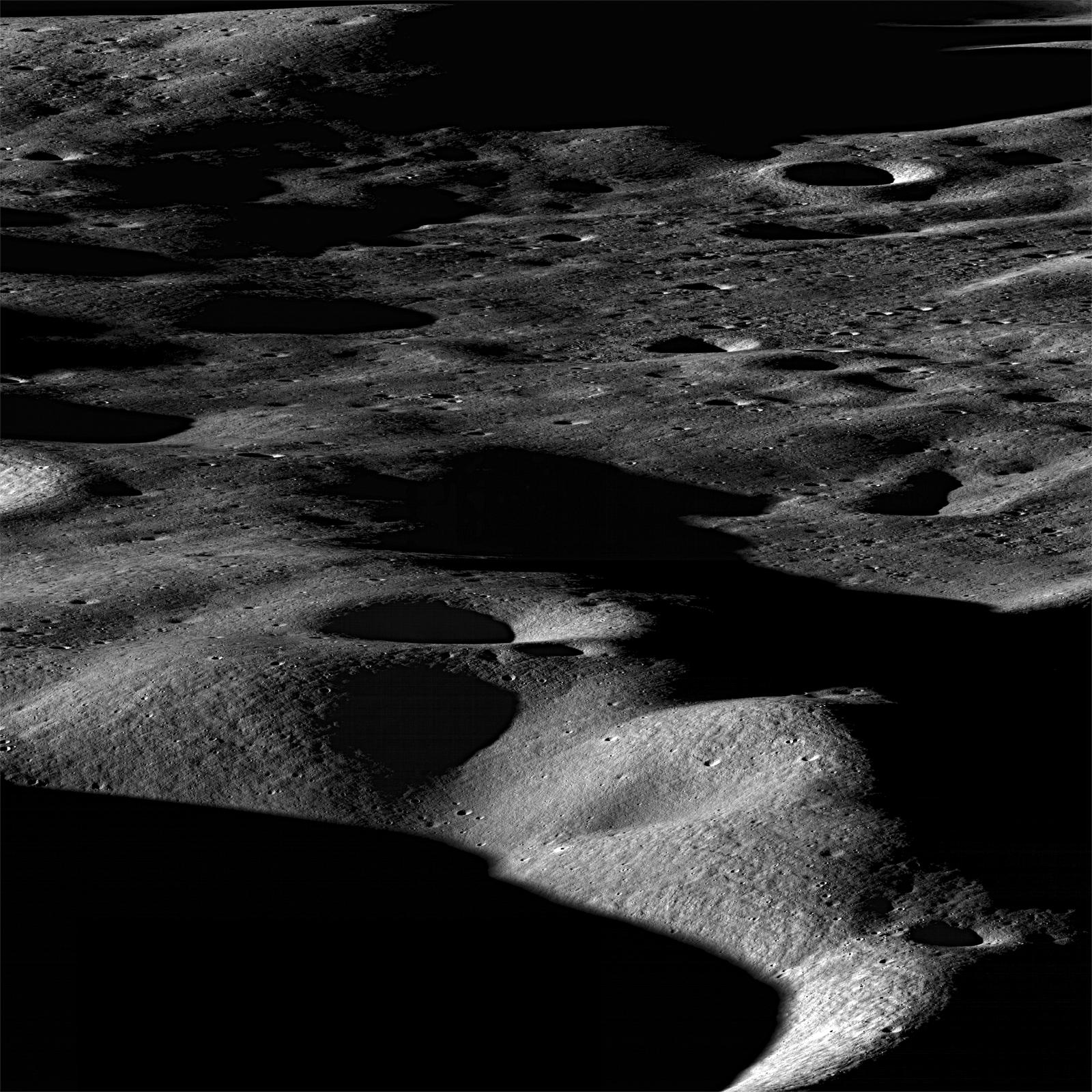
The ground below the Lunar Landing Research Facility was created to simulate the moon's surface, with craters and similar shading. Interestingly, the Lunar Landing Research Facility was created to be a research facility, but after a Lunar Landing Training Vehicle at Edwards Air Force Base crashed and deemed dangerous the simulator at Langley was used.
The facility was also used to allow astronauts to practice walking in 1/6th gravity. Astronauts were suspended from the gantry at an angle of almost 180 degrees and walked along a fence erected in the facility.