












Cloverdale Plantation Site

From NasaCRgis

(Redirected from 44HT0045)
Jump to: navigation, search
44HT045
Multimedia.jpg Back To Multimedia


Contents

[top] Tours

3D Cloverdale Plantation Site Model

3D Model

[top] History

The land currently occupying the western area of the Langley Research Center at NASA, in past years encompassed four plantations: the Chesterville Plantation; the School Neck Plantation; the Moorefield Plantation; and the Cloverdale Plantation.

The Cloverdale Plantation was derived from portions of the Moorefield Plantation, the Chesterville Plantation, and the William Moore Tract by James M. Vaughan and his son Robert H. Vaughan. The complex nature of obtaining documentation dating as far back as the early 1600’s and tracing the ownership history of any property that resided formerly in Elizabeth City County, now Hampton, can prove problematic. Despite these challenges, it is possible to reconstruct a general outline of the history of Cloverdale from the initial settlement in the area, through the Civil War, and ending with the demolition of the house in 1955.

The rich, historical nature of the Cloverdale Plantation is shown through the very essence of its background. Originally, the English Crown granted part of what developed into the Cloverdale property to Thomas Garnett. The Crown granted Thomas Celey land, later incorporated in the Cloverdale property, upon his coming to America in 1611, as well. Thomas Celey later sold the land to Major William Wilson on July 31, 1695. The heirs of William Wilson then married the Smiths, who married into the Vaughan family; thus, the land stayed within family ties until 1879 when it sold to the Schmelz family. Nonetheless, the land obtained by Thomas Garnett, thought to have made up part of the Wythe estate, was the first land in the area to be patented having taken place in the year 1635. The land granted to Garnett resided, “bounding upon Dictoris Christmas, East upon the head of Little Poquoson Creek, Southwest into the woods, and due West upon George Hull his ground…” During the same year, John Moore obtained land, “lying and being North upon the Little Poquoson Creek, East butting upon the land of Thomas Boulding, West upon the land of Thomas Garnett, and running South into the woods toward the head of broad Creek...”

Forty-one years later, Thomas Wythe Sr. had purchased an unknown acreage of this property, and gave his daughter, Constant Wythe fifty acres upon her marriage to John Tomer, who likely built the first house on the tract. By 1676, the Cloverdale Plantation house, situated on the William Moore Tract, remained under the ownership of the Wythe family until 1735 when the Moore family gained possession.

In 1735, Augustine Moore purchased fifty acres of land from James Tomer, the grandson of Thomas Wythe I and son of John Tomer and Constant Wythe. The home stayed in the Moore family for roughly thirty-five years. The addition of four more rooms onto the house, situated on the tract, occurred two years following. In 1747, Captain Augustine Moore bought the Tomer land, and his nephew, Augustine Moore, inherited the property that same year. In 1782, Augustine’s oldest son, William, maintained ownership of record for the tract and the thought that William built the Cloverdale Plantation home remains a common conception. William grew grain, had five horses and 48 head of cattle, sixteen slaves, and an overseer for the farm. Upon his father’s death in 1795, William moved to his father’s 200 acre farm (the Moorefield Plantation) and his brother Augustine Moore inherited the 50 acre tract.

Documentation, in the form of deeds, shows the transfer of land, in 1804, from William Moore to Augustine Moore Jr. and seven years later, in 1811, a transfer from Augustine Moore Jr. to James M. Vaughan. Then, in August of 1816, James M. Vaughan purchased the 50 acres making up the Moore Tract. He inherited 550 acres of land in 1819, along with part of Chesterville from Houlder Hudgins. In 1830, James M. Vaughan inherited Cloverdale from his father-in-law Houlder Hudgins and added the two and one half story addition to the original, colonial plantation home.

Upon James’s death in 1850, Vaughan’s son Robert H. Vaughan inherited Cloverdale and making it his home, lived with his wife, Lavinia C. Vaughan, their six children, and their overseer John Dillard. The plantation contained 54 slaves, ages 1-70, who farmed 400 of the 600 acres that made up the plantation. Additional tracts acquired by Robert established the estate known as Cloverdale. The house located on the tract gained an additional five rooms one year later.

In 1856, Vaughan died and his son James Vaughan inherited the property. James Vaughan moved into Cloverdale with his wife and children. James died in late 1866 or early 1867, without a will. As a result, the Chancery Court ordered the property auctioned and in 1874, Francis Schmelz purchased 300 acres including the Cloverdale house for $3,400.00. In 1878 Schmelz and his wife Angelina gave the tract to their daughter Nannie Belle Collier and her husband Howard F. Collier, along with another portion of the Vaughan estate known as School Neck. Furthermore, the 1878 marriage between Nannie Belle Schmelz and Howard F. Collier first linked the lines between the Schmelz and Collier families. In 1942, National Advisory Committee for Aeronautics (NACA) obtained the Cloverdale tract from the Colliers, and the house was used for an activities center until dismantled the Cloverdale house in 1955. The land making up the Collier estate now remains a part of the Langley Field.

CloverdaleJune53.jpg

House visible on left during 1953 carnival

CloverdaleAug53.jpg

Aug 1953 Award Ceremony for Safety

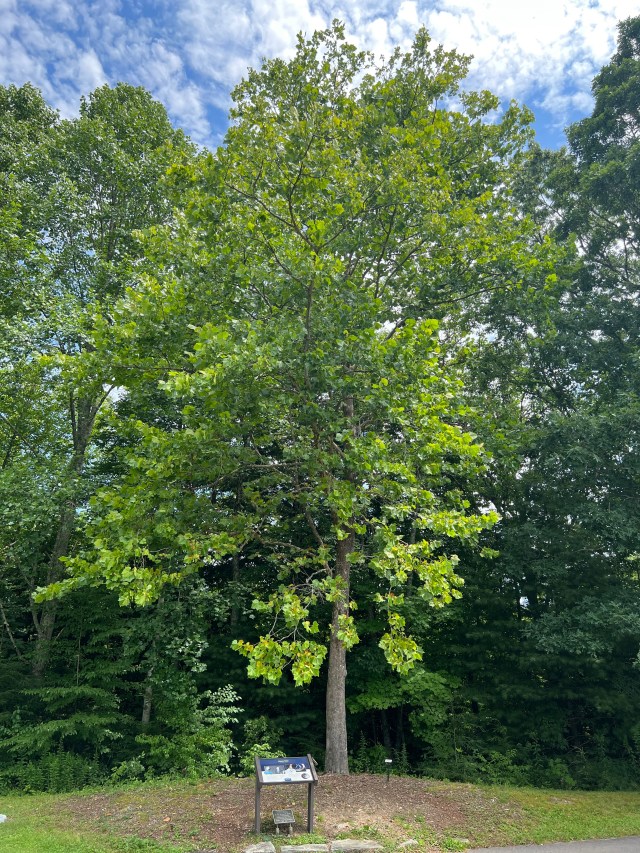
The site of the Cloverdale Plantation house, now referred to as 'Colonial Grove,' serves as a recreational area comprised of a few large trees that remain survivors of the Colonial period. In 2003, during hurricane Isabel, several of the trees became uprooted and were consequently lost.

The artifacts found during archaeological surveys completed of the Cloverdale estate totaled 1,920 and included such items as ceramics, pipes, and small pieces of toys. Moreover, a recommendation has been made to include this site on the National Register of Historic Places due to its association with both the history of slavery and land development in the area. A historical marker displays the history of this area dating back to 1635.

See the Plantations Timeline.

[top] Interpretive Garden

In 2011, NASA entered into a Space Act Agreement with the Moore House Society of the Children of the American Revolution (CAR) to implement an interpretive garden for educational purposes and to better publicize the Cloverdale Plantation Site. The garden plot is 24 feet by 24 feet and is enclosed on three sides with a gothic picket fence and on the fourth side by an existing hedge from the time of Cloverdale. The garden includes four mounded garden beds at each corner and a center mounded bed with a sundial installed. All the small trees selected for the garden are native to Virginia and the beds are planted with herbs and plants typically grown in colonial kitchen gardens. The garden will also serve as a Virginia Native Plant nursery. Continue with photos and additional information on the identification and uses of the individual plants.

[top] Photos

[top] Cloverdale House

The Wythe family owned this track from 1676 until 1735 with the Augustine Moore family gained possession of about 50 acres. In 1767, a descendant also named Augustine, inherited three plantation from his father, establishing him as a landowner of some estate. The inheritance including this piece of property. Augustine remained the owner of 'Cloverdale' until 1811.

[top] Moore House, Yorktown

In 1768, Augustine purchased 'Temple Farm' in Yorktown and eventually moved his wife and son into that house, now know as the Moore House. Besides resembling the architecture of Cloverdale, the Moore House is a site of national significance. At 10 o'clock on the morning of October 17, 1781, a drummer beating a "parley," and a British officer with a flag of truce, mounted a parapet south of Yorktown. The allies saw the signal, and soon the incessant, devastating artillery fire ceased. A hushed stillness fell over the field. Lord Cornwallis, realizing the defeat of his army was inevitable, send a message to General George Washington:

"Sir, I propose a cessation of hostilities for twenty-four hours, and that two officers may be appointed by each side, to meet at Mr. Moore's house, to settle terms for the surrender of the posts of York and Gloucester/"

[top] Maps

[top] Vaughan Family Cemetery

Cemetery Records

1853 Virginia Register of Deaths

[top] Archaeology

[top] Documents

1635-1942 History of the Ownership of Cloverdale

1635-1942 Pedigree of Cloverdale

1850 Census

Vaughan Legislative Petitions

Wills Beginning in 1762

1782-1794 Land Records

1795-1813 Land Records

1814-1820 Land Records

1821-1826 Land Records

1854 Cloverdale Survey Notes

1878 Cloverdale Deed

1937 WPA Report

1937 Vaughan Tombstone Inscriptions

NACA List of People in Vaughan Cemetery

Langley Field Cemetery Records

1955-11-18 Air Scoop, Collier Home Being Razed

1973 Dr. Frank Farmer Excavation Photos

1973 Artifacts List

1976 Revolutionary War Public Service Claim Records

1976 Letter to Hugh Watson from Carrie Vaughan

2000 Family Correspondence

2005 Damage Assessment

2005 James River Institute Phase II Survey

Cloverdale

Cloverdale Notes

Cloverdale Signs

Map of Subsurface Utilities Drawing

Sword Hilt Xray

[top] For Students and Teachers

Early American History

Personal tools
Navigation