











8-Foot High Speed Tunnel

From NasaCRgis

Jump to: navigation, search
Facility 641
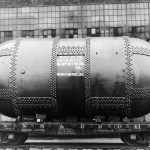
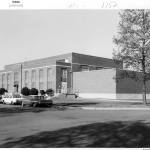
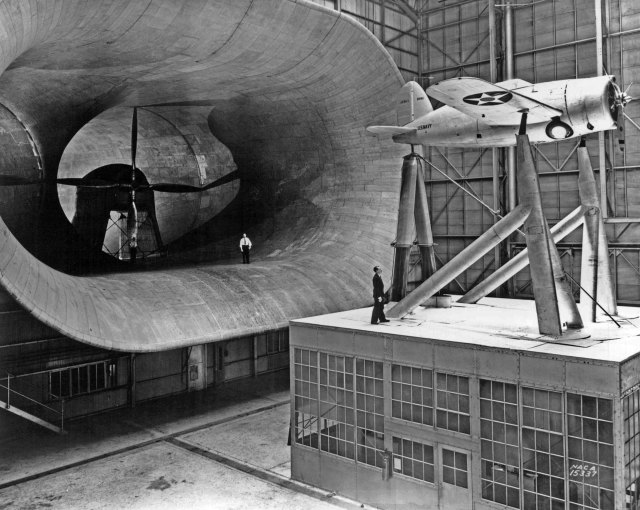
1936 Exterior View

Center: Langley Research Center
Location: Hampton, Virginia
Year Built: 1936
Historic Eligibility: National Historic Landmark
Important Tests: Lockheed P-38 Fighter, A-26B Invader,Development of "area rule"


Multimedia.jpg Back To Multimedia

Contents

[top] Tours

Virtual Tour of Facility

Open 3D Model

[top] History

As interest in the field of high-speed aerodynamics increased in the early 1930s, Langley’s existing wind tunnels proved too small and underpowered for effective high-speed aircraft testing. Understanding that a new facility would give U.S. engineers a decided advantage in the aeronautical field, Langley’s director of research George W. Lewis authorized the design and construction of a larger high speed wind tunnel in 1933. Construction of the 8-Foot High Speed Tunnel (HST) was funded by the Public Works Administration (PWA) and completed in 1936 at a cost of $266,000.

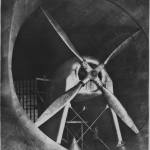
Within a short time, the aluminum fan blades suffered from fatigue failure. Retired researcher John Becker remembers that:

About a year later at 3:06 a.m. on October 8, 1937, I was running the tunnel at full power and had just promised the operator at the Hampton generating plant that I would reduce power gradually when, without warning, there was a sickening break in the steady roar of the 550-mph wind. Acrid smoke filled the test chamber as I pushed the red emergency button, no doubt blowing the safety valves in Hampton. On entering the tunnel we found the huge multi-bladed drive fan twisted and broken. The cast aluminum ally blades had failed in fatigue from vibrations induced by their passage through the wakes of the support struts. Operations were suspended until March 1938, and the staff was temporarily dispersed to other sections. (see NASA SP-445).

When Becker was interviewed in 2011, he remembered this accident in detail and added that this was the stimulus to change all wind tunnel propeller blades to wood.

The world’s first large high speed tunnel, the HST proved vital during World War II. Evaluating stability-control problems of the Lockheed P-38 Lightning fighter in the 8-Foot HST, Langley engineers devised the “dive recovery flap,” a wedge-shaped flap on the lower surface of the wings that allowed sufficient lift for a pilot to pull out of steep dives. This ingenious feature subsequently was incorporated in the design of a number of U.S. fighter aircraft, including the YP-38 Lightening, the P-47B Thunderbolt, the A-26B Invader, the P-59 Airacomet (the first U.S. jet aircraft), and the P-80 Shooting Star.

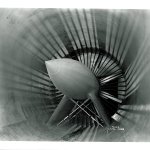
In the postwar years, Langley physicist Ray H. Wright observed that interference from wind tunnel walls could be minimized by placing slots in the test section throat, a concept that came to be known as “slotted throat” or “slotted wall tunnel” design. By the end of 1948, the 8-Foot HST had been retrofitted with the new slotted test section configuration, allowing speeds in excess of Mach 1 (the speed of sound, or approximately 761 mph at sea level). Wright and his team used the tunnel to refine the slotted-throat design, and—after modifications—the facility was re-designated the 8-Foot Transonic Tunnel (TT) in October 1950.

In the mid-1950s, the 8-Foot TT facilitated important research in body/wing design for supersonic aircraft. Langley engineer Richard Whitcomb used the tunnel to develop the revolutionary “area rule” principle that — in practical terms — prompted the use of a compressed, or “wasp-waisted,” fuselage design for supersonic jet fighters, allowing them to break what was popularly known as the “sound barrier.” Subsequent testing of area-rule aircraft designs was conducted in the adjacent tunnel, the 8-Foot Transonic Pressure Tunnel. Whitcomb’s once controversial area rule achieved widespread acclaim in the scientific community and the popular press, and he was awarded the Collier Trophy for the greatest achievement in aviation in 1955.

The TT continued in use until 1961, when it was deactivated by NASA. The facility was kept in operational condition until 1976 when critical parts were sent to Wright-Patterson Air Force Base in Ohio and used in the construction of a new facility. Since then, the 8-Foot TT building has been used as office and storage space. The historical significance of the facility and its many contributions to aerospace technology (first continuous-flow high-speed wind tunnel for large test models and actual plane parts and also the landmark 'slotted-throat' design -see NPS site) were recognized when it was designated a National Historic Landmark in 1985.

The office portion of the structure was remodeled and leased to the Langley Air Force Base in the early 2000s, while the tunnel circuit was left to deteriorate. In 2011, the tunnel circuit was demolished.

[top] Photos


[top] Condition and Demolition (2011)

[top] Films

NACA-Era: P-47 Metal Rudder Flutter Test

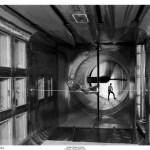
1946: Human Tolerance to Wind Blasts

1950s: Dr. Theodorsens Flutter

1951: Schileren

[top] Interviews

[top] Documents

1933-1936 Eight Foot High Speed Wind Tunnel

1939 Floorplan

1942 Datasheet

1945 Investigation of Typical High-Speed Bomber Wing

1947 Investigation of Practical Application of Slotted Wind Tunnel

1948 Development of a Slotted Supersonic Test Section and its Application to 8' HST

1951 Installation of 22,000 Horsepower Drive

1952 John Stack Acceptance Speech for Recognition from Collier Trophy Committee and Biography

1955 Air Scoop Vol. 14 Issue 47

1957 NACA Slot Shapes Research Paper Ray Wright

1965 Brief Description of 2-Foot Hypersonic Facility

Section of "Wind Tunnels of NASA" site describing "The First Big High-Speed Tunnel (8-Foot High Speed Tunnel--641)

1984 National Register Nomination

1992 Procedures to Repair 8' HST

1995 Historic American Engineering Record

1995 Library of Congress: American Memory

2001 National Park Service, Man In Space; A National Historic Landmark Theme Study

2006 Historic American Engineering Record 8 Ft HST Addendum

Characterisitics of the Langley 8-Foot TT with Slotted Test Section

Development of Slot Shape

Paragraph Published in Virginia Landmarks Register on the 8' High Speed Tunnel

[top] Technical Reports

Wind Tunnel Tests of a Submerged Engine Fuselage Design. 1940.

The Effect of Spinner-Body Gap on the Pressures Available for Cooling in the NACA E-Type Cowling. 1943.

High-Speed Wind Tunnel Investigation of the Longitudinal Stability and Control Characteristics of a 1/16-Scale Model of the D-558-2 Research Airplane at High Subsonic Mach Numbers and at a Mach Number of 1.2. 1949.

Investigation of the Static Longitudinal Stability Characteristics of an Air-to-Surface Canard Missile Configuration in the Transonic Mach Number Range. 1960.

The High Speed Frontier. John V. Becker. 1980.

From Engineering Science to Big Science. Pamela E. Mack, edit. 1998.

U.S. National Register of Historic Places
Keeper of the Register · History of the National Register of Historic Places · Property types· Historic district · Contributing property
List of entries
National Park Service · National Historic Landmarks · National Battlefields · National Historic Sites · National Historical Parks · National Memorials · National Monuments


Personal tools
Navigation