










Historic Site and Building Pages

From NasaCRgis

(Redirected from Langley Media)
Jump to: navigation, search
Back Arrow.jpg Back To Langley Research Center


Contents

[top] Pre NACA/NASA Sites and Archaeological Resources

Historic Sites

In addition to documentary research, archaeological surveys and investigations have been performed at LaRC which have identified several historically significant plantation sites. Southern Virginia was a primary area of conflict during the War Between the States. Nearby Big Bethel was the scene of conflict as Union troops advanced on Southern forces. The area remained rural and agrarian into the nineteenth century. During this time, three plantations covered the current LaRC property: Chesterville (700 acres), Cloverdale (600 acres), and Moorefield (225 acres). The adjacent Langley Air Force Base property contained the remaining plantations below.


Plantations are not the only interesting archaeological features. Other sites include a subsistence farm associated with the Ross family, the historic Kings Road and even 3.5 million year old whale bones. Additionally, the Syms Free School which was the first free public school in America was originally located on what is now NASA LaRC property.


NASA LaRC Plantations

LAFB Plantations

Other NASA LaRC Sites

[top] NACA/NASA Architectural Resources

The architectural resources at LaRC date solely to the twentieth century and were built as part of the operation of NACA and NASA. Historic contexts that are pertinent to this time span are World Wars I and II through the Cold War and Man in Space program. Many of the buildings and structures at LaRC have unique and specialized design features related to the development of aerodynamic technology and space exploration.

Architectural resources at LaRC have been documented in three separate surveys. In 1985, the National Park Service (NPS) performed a survey as part of the Man in Space theme study which identified resources that significantly contributed to the Apollo Program. The survey resulted in five LaRC properties being listed in the National Register as National Historic Landmarks (NHLs). In 2007, NASA performed an agency-side survey of facilities and assets that supported the Space Shuttle Program (SSP). Several facilities at NASA LaRC were evaluated as part of this survey and the Landing Loads Facility was determined to be potentially eligible for the National Register (NR) within the context of the SSP.

In 2010, NASA LaRC completed a comprehensive reconnaissance level architectural survey of all buildings and structures located throughout the Center. In addition to determining the NR eligibility of 271 resources, the survey identified the NASA LaRC Historic District as potentially eligible for the NR. Results of the survey were incorporated in the Programmatic Agreement (PA) among NASA LaRC, the SHPO and the Advisory Council on Historic Preservation for management of facilities, infrastructure and sites at NASA LaRC. The survey results and PA requirements include categorizing LaRC's properties according to four Historic Preservation Priority Category codes. The PA defines the categories and LaRC's Cultural Resource Management Plan (CRMP) describes the process for complying with the requirements included in the PA. The CRMP and PA are maintained by the LaRC Historic Preservation Officer (HPO).

The Architectural Resources Map identifies LaRCs five NHLs, as well as the NR eligibility and historic district boundary information from the 2010 survey. A more detailed narrative of LaRC's NHLs can be found on the Center's public site.


[top] Wind Tunnels

[top] Other Interesting Structures

[top] Support Buildings

[top] Trailers


[top] Off-Site Facilities

[top] NASA LaRC Historic District

A historic district is defined as “a geographically definable area – urban or rural, large or small – possessing a significant concentration, linkage, or continuity of sites, buildings, structures, and/or objects united by past events or aesthetically by plan or physical development.” A district may also comprise individual elements that are separated geographically, but linked by association or history. A historic district derives its importance from being a unified entity, even though it is often composed of a variety of resources. The identity of a district results from the interrelationship of its resources, which can convey a sense of the overall historic environment. Alternatively, a district can be an arrangement of historically or functionally related properties.
Historic District Boundaries

A district can comprise both features that lack individual distinction and individually distinctive features that serve as focal points. A district may even be considered eligible for the National Register of Historic Places if all of the components lack individual distinction, provided that the grouping achieves significance as a whole within its historic context. In either case, the majority of the components that add to the district’s historic character, even if they are individually undistinguished, must possess integrity, as must the district as a whole.

As noted in the Architectural Resources section above, the results of a center-wide survey completed in 2010 identified a potential historic district at NASA LaRC that included buildings and structures located in both the East and West areas. The district boundaries are shown on the map at the right.

As part of its stewardship responsibilities under the National Historic Preservation Act, NASA LaRC decided to nominate the NASA LaRC Historic District to the National Register. The nomination was approved by the Virginia State Review Board in December 2011, resulting in the district being listed on the Virginia Landmarks Register. In June 2012, the historic district was formally listed on the National Register of Historic Places. Key elements of the nomination, to include the historic district's Statement of Significance. Period of Significance, and description of Integrity are provided below.

[top] Statement of Significance

NASA LaRC—the successor of the NACA’s Langley Memorial Aeronautical Laboratory (LMAL) and the Langley Aeronautical Laboratory (LAL)—was the nation’s first civilian aeronautics laboratory and played a principal role in the American aerospace story. From its beginnings in 1917, NASA LaRC has examined complex and groundbreaking issues associated with flight and space travel. Collaborative research conducted in wind tunnels and laboratories, as well as testing of research aircraft, spacecraft, and flight simulators at NASA LaRC have led to significant advances in American aeronautical and space research and technology.

Phase I reconnaissance survey identified a potential NASA LaRC historic district with extant buildings and structures in both the East Areas and West Areas that illustrate the major contributions and advances made by NASA researchers in the fields of aeronautics and space flight. The district is eligible for listing in the National Register under Criterion A and C because of major contributions these facilities made to aeronautics and space research and testing. The district is significant at the national level in the areas of science, engineering, military, defense communication, and transportation. The historic district’s defined period of significance begins in 1917 with the date of the earliest surviving facility until the end of the Apollo Program in 1972.

Applicable National Register Criteria

Criterion A – Association with events that have made a significant contribution to the broad patterns of our history

The NASA LaRC historic district is eligible under Criterion A for its association with significant events in aeronautics and aerospace engineering research and the United States space program. Important scientific concepts and aeronautical and space research programs and projects were developed and implemented at the NASA LaRC, and several facilities house important research equipment designed specifically for conducting these unique tests and studies. The historic context identifies the major accomplishments and contributions of the NASA LaRC during the recommended period of significance.

Criterion C – Embodies the distinctive characteristics of a type, period, or method of construction, that represent the work of a master, or that possess high artistic values, or that represent a significant and distinguishable entity whose components may lack individual distinction.

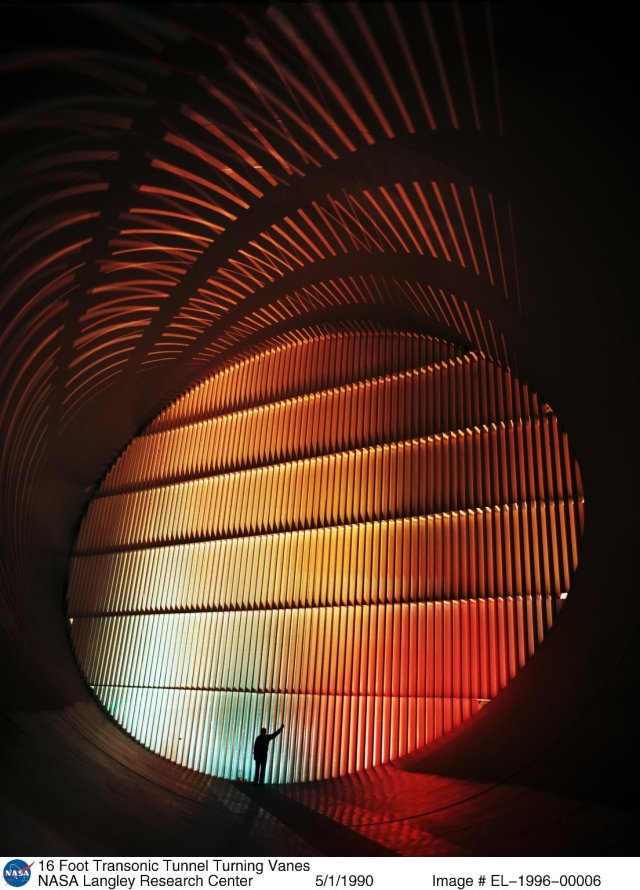
The NASA LaRC historic district is eligible under Criterion C for examples of significant works of engineering. Examples of resources that fall under this category are the specialized research facilities such as the wind tunnels and the Landing Loads and Traction Facility. While many of these facilities retain their basic structural elements, upgrades and modifications over the years have resulted in select alteration and replacement of various building elements. In the majority of cases, however, these changes have not substantively affected the overall integrity of the resources such that they would not be considered eligible for listing in the National Register.

As NACA expanded in the West Area beginning in the late 1930s, construction of administrative and support facilities increased. Common architectural themes include two and three story stripped classical style brick buildings and Art Moderne construction. While indicative of industrial and post war construction, these buildings are not unique and are not unusually good examples of the execution of these building styles either individually or collectively and were not considered eligible for listing in the National Register under criterion C.

[top] Period of Significance

The period of significance for the NASA LaRC historic district encompasses the period from 1917 until 1972. This period includes resources located both in the East Area and in the West Area. Typically, properties less than 50 years of age are not considered eligible for listing in the National Register unless they meet Criterion Consideration G, which provides for resources of exceptional significance to be considered eligible. In this particular case, the period of significance ends at a date that is less than 50 years in order to include those resources associated with the Apollo Program. Highlights of the events that focus and define the period of significance of the historic district include:

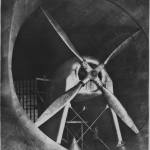
• With the dedication of its new Langley Memorial Aeronautical Laboratory (LMAL) in 1920, the National Advisory Committee for Aeronautics (NACA) soon began conducting groundbreaking research in its new, state-of-the-art facilities such as the Variable Density Tunnel and Propeller Research tunnel, resulting in major advances in military and civilian aircraft design and performance.

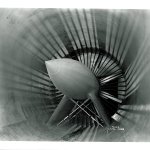
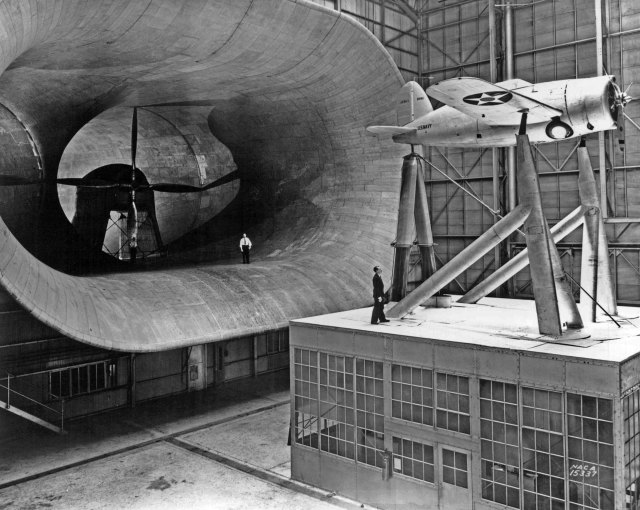
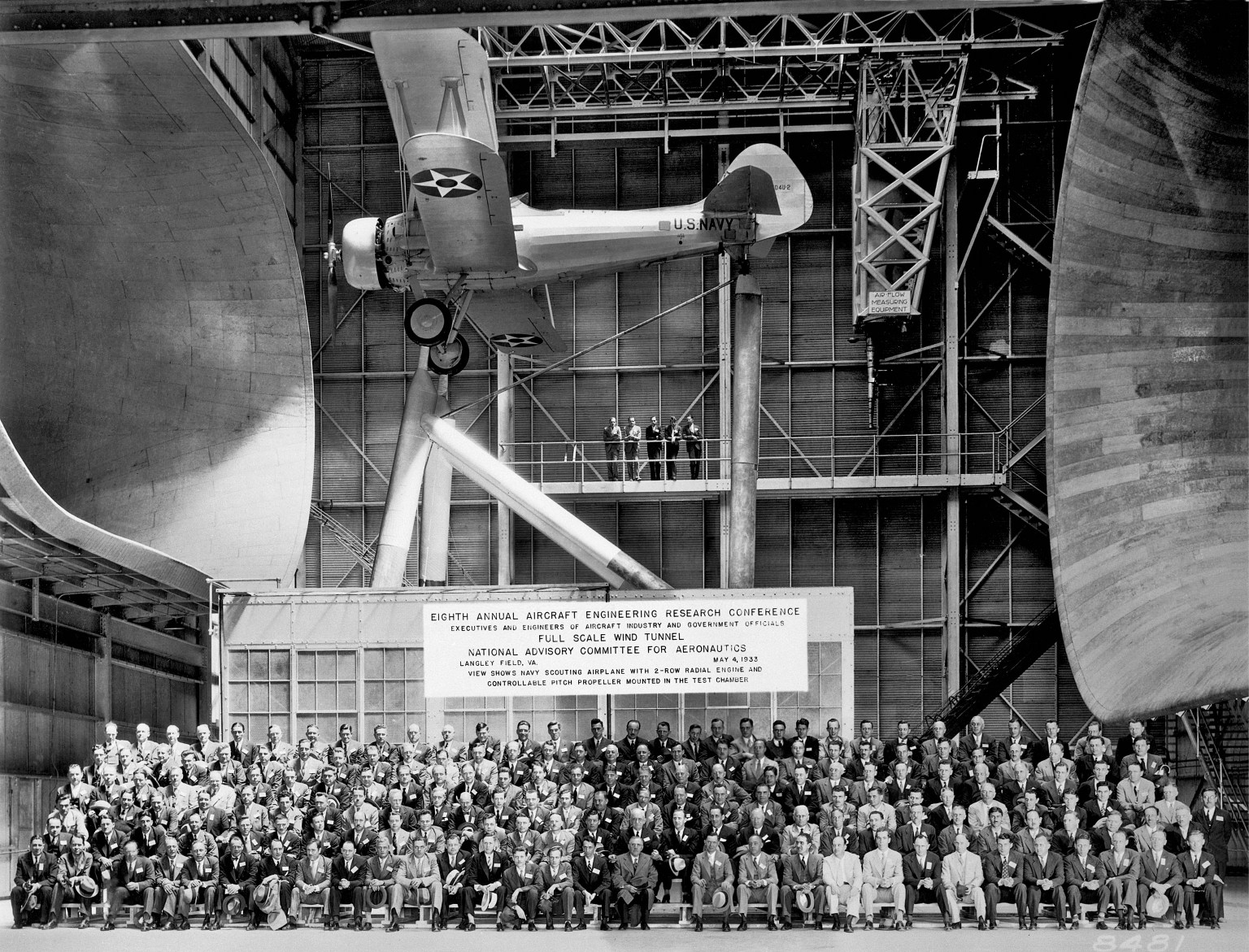
• Despite the Depression, the LMAL continued to pursue significant new large-scale building projects in the 1930s such as the Full Scale Tunnel, at the time the world’s largest wind tunnel.

• In 1938, a Special Committee recommended expanding the LMAL to relieve the “congested bottleneck” conditions in the original tract (the “East Area”) on Back River. The first parcel of 73 acres in the new “West Area” was acquired 1939, and by 1945 had expanded to 176 acres.

• During World War II, the LMAL played an essential role in military aircraft testing, considerably advancing the American war effort. The war years witnessed the rapid growth of research, administrative, and support facilities in the new West Area to support this significant research.

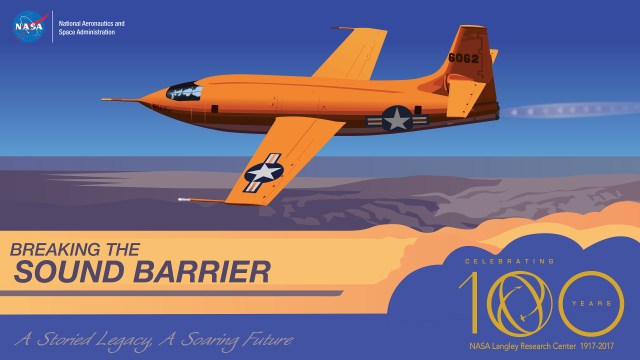
• Major advances in aircraft speed and performance (e.g. jet propulsion, rocketry, and transonic/supersonic flight) set the agenda for postwar research, and the LMAL played an essential role in the development of missile technology with the establishment of the Pilotless Aircraft Research Division at Wallops Island, Virginia.

• The LMAL was renamed the Langley Aeronautical Laboratory in 1948, and the late 1940s and early 1950s witnessed another rapid period of growth, with the construction of new wind tunnels that could accommodate supersonic testing based on Langley engineer Ray H. Wright’s revolutionary refinement of “slotted throat” tunnel design.

• During the 1950s, advances in aeronautical research at the LAL continued to shape the development of supersonic flight, an outstanding example of which was Richard Whitcomb’s award-winning concept of the “area rule” for the design of high-speed aircraft.

• The NACA was superseded by the National Aeronautics and Space Administration (NASA) in 1958, and the LAL was renamed the Langley Research Center (LaRC). That same year, Project Mercury was inaugurated with the goal of putting a manned spacecraft in orbit. The Space Task Group (STG), which was established to oversee the project, initially was headquartered at the LaRC. The “Mercury Seven” astronauts conducted training there, its tunnels tested spacecraft performance, and STG staff developed an unprecedented international tracking system for the program.

• In 1961, the STG was replaced by the Manned Spacecraft Center (MSC), and in June 1962 was relocated from the LaRC to a new site near Houston, later named the Johnson Space Center.

• Aerospace research and testing continued at the LaRC after the relocation of the MSC. LaRC researchers developed Echo 1, the first communications satellite, and played a supporting role in Project Gemini, the next manned space program.

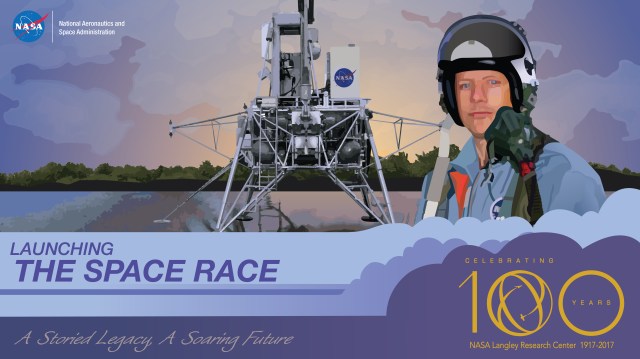
• Langley’s major contribution to the Apollo program was the establishment in 1965 of the Lunar Landing Research Facility (LLRF), a lunar gravity simulator that allowed astronauts (including Neil Armstrong and Buzz Aldrin of Apollo 11) to train in piloting the Lunar Excursion Module (LEM), resulting in the first successful moon landing only four years later in July 1969.

The defined period of significance for the NASA LaRC Historic District ends in 1972, coinciding with the end of the Apollo Program.

[top] Integrity

NASA LaRC’s aeronautical, engineering, and aerospace research facilities are unique both in form and function and retain a remarkable degree of integrity. The wind tunnels, laboratory buildings, hangers, etc. reflect the district’s principal activities and mission during the proposed period of significance. While some of the earliest test facilities have been removed (Wind Tunnel Building # 1149, the Gust Tunnel Building # 1218, and the Seaplane Impact Basin Building # 1192) their associated research buildings are still extant and have been adaptively reused.

As a whole, the majority of the components of the NASA LaRC historic district possess sufficient integrity to convey the district's historic character and function. The relationship of the various components from the period of significance is largely unchanged, and the relative number, size, scale, design, and location of the proposed noncontributing components do not overwhelm the observer or negatively detract from the proposed district.

While the NASA LaRC historic district does not retain all of its historic physical features or characteristics, it does include a sufficient number of essential physical features that convey the character and appearance of the district during its association with significant advances in aeronautics and space flight.

[top] From Biplanes to Apollo: The NASA Langley Historic District

As stipulated in LaRC's Programmatic Agreement, one of the mitigation measures for LaRC's New Town Project required preparing a history of the historic district. Written by Joseph R. Chambers, a retired NASA researcher, the 70-page booklet provides a history of LaRC from 1917 to 1972 and includes its contributions to the technological development of manned flight from fabric-covered biplanes to the dramatic moon missions of Apollo. Copies of the booklet have been distributed to local library and school systems, museums, visitor's centers to include the Virginia Air and Space Center, Historical Societies, the Virginia State Historic Preservation Office, the Advisory Council on Historic Preservation, the National Park Service, other NASA Centers, and the NASA History Office.


[top] CRMP - Cultural Resource Management Plan

NASA LaRC developed a Cultural Resource Management Plan (CRMP) to assist LaRC personnel in managing the Center's historic sites and buildings. The CRMP ensures that LaRC complies with the National Historic Preservation Act (NHPA) and with additional federal preservation laws and guidelines, including Executive Order 13287, "Preserve America". The CRMP identifies processes for integrating cultural resources management (CRM) with the mission and programs of LaRC. The integration should be executed in a manner that recognizes the significance of historic properties, the importance of the LaRC's mission, and the agency's responsibility as manager and custodian of historic properties under federal jurisdiction.

The scope of the CRMP cross-cuts many projects, operations and maintenance activities that occur at NASA LaRC. Although oversight of CRM at the Center is primarily the responsibility of the LaRC Historic Preservation Officer (HPO), LaRC personnel involved in project planning and implementation must be aware of the requirements of the CRMP and have the responsibility to work with the HPO to see that the requirements are carried out. Organizations, staff and contractors at LaRC that may encounter CRM issues include those involved in land use and planning decisions, buildings and structures maintenance, construction and engineering activities, utilities and communications systems, environmental resources management, and safety and security. Copies of LaRC's CRMP are available for download.

Specific undertakings that may affect cultural resources at LaRC include the following:

  • Construction of new facilities
  • Renovation, repair or demolition of facilities
  • Utility systems repair, installation, or upgrade
  • Landscaping
  • Wetlands mitigation
  • Hazardous materials cleanup/remediation
  • Traffic and parking related construction
  • Property leasing and exchange


In performing CRM activities, the terms "cultural resources" and "historic properties" are used frequently. The terms are defined below:

Cultural resources - any prehistoric or historic building, structure, object, site or district considered important to a culture, subculture, or community for scientific, traditional, religious or other purposes. They include architectural, archaeological, and traditional resources. Architectural resources are standing buildings, dams, canals, bridges, and other structures of historic or aesthetic significance. Archaeological resources are locations where prehistoric or historic activity measurably altered the earth or produced deposits of physical remains (e.g., arrowheads, bottles). Traditional resources are associated with cultural practices and beliefs of a living community that are rooted in its history and are important in maintaining the continuing cultural identity of the community.

Historic properties - those cultural resources that are listed in, or eligible for listing in the National Register of Historic Places (NRHP or National Register). Information about the National Register is available at: http://www.nps.gov/history/nr/listing.htm

Personal tools
Navigation